
From Promising To Rule For 60 Years To Two Governors: Tracing The Collapse Of PDP
Once Nigeria’s most dominant political force, the Peoples Democratic Party (PDP) has seen its grip on power steadily weaken amid internal crises, leadership battles, and mass defections that have reshaped the country’s political landscape.
In December 2008, the National Chairman of the PDP, Chief Vincent Ogbulafor, boldly declared that the party was set to rule for 60 years.
“The PDP is a party for all, and it is set to rule Nigeria for the next 60 years. I don’t care if Nigeria becomes a one-party state. We can do it, and the PDP can contain all,” he said.
At that time, the PDP controlled 28 governorships and enjoyed a comfortable majority in both the National Assembly and state legislatures, following the infamous 2007 general elections widely criticised for being do-or-die in nature.
Four years prior, at the dawn of the Fourth Republic in 1999, the PDP had produced President Olusegun Obasanjo and 21 state governors, cementing its position as the dominant political party in Nigeria.
NGF Crisis and Internal Rebellion
However, Ogbulafor’s ambitious prediction began to unravel five years later during the Nigeria Governors’ Forum (NGF) crisis. In May 2013, the NGF held an election in which then-Governor Rotimi Amaechi of Rivers State was re-elected chairman, defeating Governor Jonah Jang of Plateau State 19 to 16.
The election exposed deep fissures within the PDP. Amaechi and several governors had fallen out with President Goodluck Jonathan, while Jang enjoyed the President’s backing. This period became notorious for the slogan: “16 is greater than 19” within the party.
The Jang bloc formed a parallel structure with its own secretariat in Abuja and held meetings recognised by Jonathan, while Amaechi’s group was labelled rebellious.
By 9 December 2013, five PDP governors — Aliyu Wamakko (Sokoto), Murtala Nyako (Adamawa), Abdulfatah Ahmed (Kwara), Rabiu Kwankwaso (Kano), and Amaechi — defected to the newly formed All Progressives Congress (APC), marking the beginning of the party’s long decline.
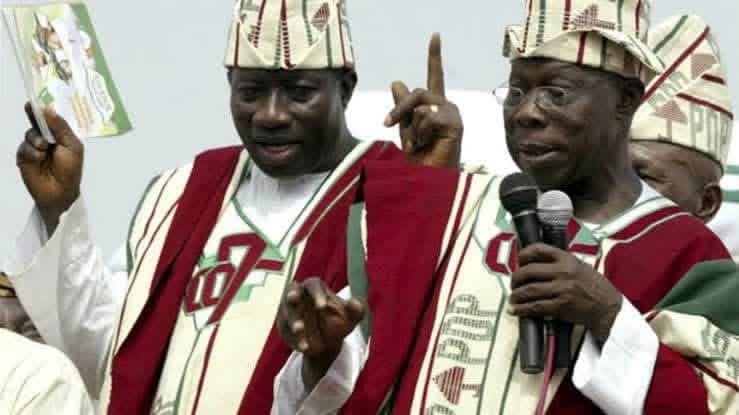
The party suffered another major blow when former President Obasanjo quit and publicly tore his PDP membership card, signalling his disapproval of its internal conduct.
Yet former military Head of State Gen. Ibrahim Babangida (rtd.), who noted that the PDP was initially conceived by ex-military leaders, stated on 11 March 2017 that the party could still endure for 60 years if it managed to restore order within its ranks. Unfortunately, instead of stabilising, the PDP slid from one crisis to another, each inflicting further damage on its cohesion and national influence.
2023 Primaries and the G-5 Revolt
The lead-up to the 2023 presidential primary exposed yet deeper internal fractures. While former Vice President Atiku Abubakar insisted on contesting, a faction known as the G-5, led by Nyesom Wike (Rivers) and Seyi Makinde (Oyo), believed it was the South’s turn to produce the President after the eight-year tenure of late President Muhammadu Buhari.
Wike, aiming for the vice-presidential slot, was sidelined in favour of Ifeanyi Okowa, then governor of Delta State, further heightening G-5 grievances.
This infighting reduced the PDP from a cohesive force to a faction-ridden party, undermining its campaign ahead of the 2023 elections. Wike and other G-5 members even worked to ensure President Bola Tinubu’s emergence, partly as a rebuke to Atiku.
Efforts to reconcile the factions included removing National Chairman Iyorchia Ayu and appointing Umar Damagum as acting chairman, perceived as loyal to Wike. Yet Damagum’s loyalty was challenged during the struggle to remove National Secretary Sam Anyanwu, an ally of the FCT Minister.
The revolt escalated when the South-East zone nominated Sunday Ude-Okoye to replace Anyanwu after the 2023 Imo State governorship election. While the PDP Governors’ Forum demanded Anyanwu’s removal, Wike and his allies backed him. Court battles and internal wrangling further fractured the National Working Committee and Board of Trustees.
Controversial Convention and Expulsion Wars
On 25 November 2025, the Damagum camp, backed by four PDP governors, conducted a national convention defying two Federal High Court orders. The exercise produced a new National Working Committee led by Tanimu Turaki, and saw the expulsion of Wike, Anyanwu, Kamaldeen Ajibade (SAN), former Ekiti governor Ayo Fayose, Austin Nwachukwu, and others for alleged anti-party activities.
In retaliation, the Wike bloc announced the expulsion of governors Seyi Makinde (Oyo), Bala Muhammed (Bauchi), Dauda Lawal (Zamfara), PDP Board of Trustees chairman Adolphus Wabara, former National Vice Chairman Bode George, and Turaki himself.
INEC Rejection and Legitimacy Crisis
The Independent National Electoral Commission (INEC) rejected the Ibadan convention and Turaki-led NWC, citing court injunctions, and warned that the leadership lacked legal recognition. This left PDP stakeholders uncertain, as any decisions by the apex body could be nullified if courts sided with the Wike faction.
As of the latest update, Damagum and Anyanwu remain listed as National Chairman and National Secretary.
Governors’ Defections and Shrinking Map
Since 2013, the PDP has lost at least 11 governors and numerous lawmakers. Notable defections include David Umahi (Ebonyi, 2020), Ben Ayade (Cross River, 2021), Bello Matawalle (Zamfara, 2021), Sheriff Oborevwori (Delta, 2025), Umo Eno (Akwa Ibom, 2025), Peter Mbah (Enugu, 2025), Douye Diri (Bayelsa, 2025), Agbu Kefas (Taraba, 2025), Ademola Adeleke (Osun, 2025), Siminalayi Fubara (Rivers, 2025), Dauda Lawal (Zamfara), and Ahmadu Fintiri (Adamawa).
Currently, only governors Makinde (Oyo), and Bala Muhammed (Bauchi), remain. The PDP has also lost numerous legislators. Analysts attribute this decline to impunity, political officeholder dominance, and abandonment by former leaders.
Rebuilding Efforts
PDP spokesperson Ini Ememobong insists the party can recover, emphasising a return to grassroots engagement and accountability.
“We are going back to the makers of the party — the people. We are ensuring that the voices of elected officials do not drown the collective voices of ordinary people. That is the new PDP being rebuilt on justice, equity, fairness, and transparency.”